


The Chandigarh Metro, or the Tricity Metro, is a large project of rapid transit, intended to be built Metro In Tricity Chandigarh, Mohali, Panchkula ,Zirakpur and New Chandigarh. The project will help decrease the increasing traffic congestion and enhance connectivity and a contemporary means of transporting more than 3 million people living in the area. Although the concept of the metro was developed over a decade ago, it has gone through a number of delays, modifications and cost reallocations. By 2025, the metro has received approval but awaits final clearances and corrections to the DPR to start its construction.
We will discuss about Chandigarh Metro.com: Route, Phase Network, Benefits, Budget, Major Updates and More
chandigarh metro.com: History and Revival
The Tricity region began considering a metro system in 2012 when DMRC prepared the first Detailed Project Report. At that time, the authorities believed the project wouldn’t attract enough usage and decided to abandon it in 2017 due to concerns about low viability until 2051. However, rapid population growth and worsening traffic conditions made it clear that the region needed a high-capacity transport system sooner than expected. As demand increased, RITES revived the project in 2022 by presenting a new plan and highlighting the urgent need for a metro in the coming years.
In 2023, the Central Government gave in-principle approval to proceed with the project, which is a big step into the project revival. In July 2024, officials completed the DPR, but the joint committee questioned the methodology and ridership assumptions, leading to further revisions.
The project received, in 2025 by national focus once again as MP Manish Tewari requested 25000 crore in parliament to eventually start construction of the metro.
| Official website | https://hmrtc.org.in/Tricity.aspx |
Phase 1 Network: Station Overview and Detailed Routes
In Chandigarh Metro Phase 1 will cover the most significant locations of Chandigarh, Mohali, Panchkula and New Chandigarh.
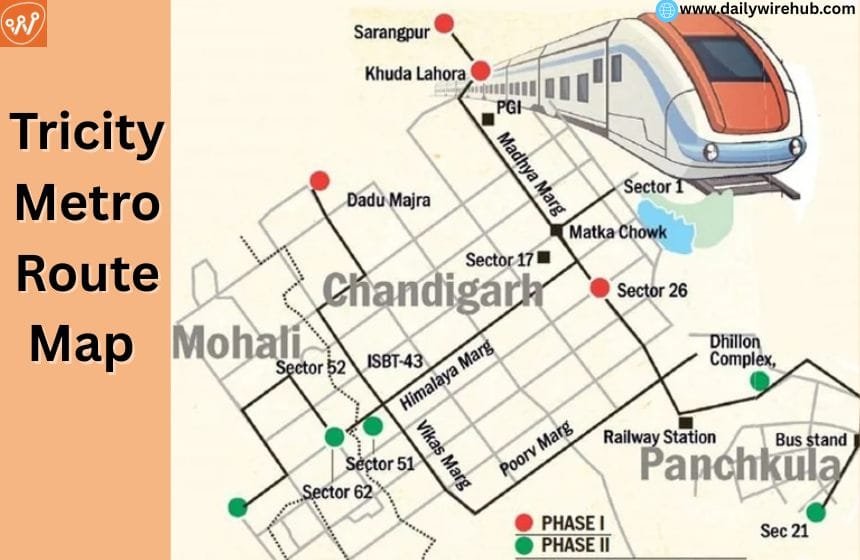
Planners designed the elevated networks mainly to reduce construction costs, adding underground sections only where necessary, such as near heritage-sensitive areas.
In Phase 1 Stage main aim is to offer regular good service likes Education areas like (Coaching Institute, Schools) Hospitals, ISTB, etc.
Upon completion, the initial phase at chandigarh metro will present an effective and time saving means of transportation to individuals who are currently relying on private automobiles and buses.
Line 1: Paroul (New Chandigarh) to Sector 28 Panchkula
The route of Line 1 will be New Chandigarh to Panchkula, which will link numerous significant areas including PGI, Panjab university, Sector 26 and the Chandigarh Railway Station. This pathway will be very convenient to students, office workers and patients who frequent hospitals in the city since they will spend less time traveling around the city. The route also has a lot of potential to enhance real estate value within the New Chandigarh region.
Line 2: Sukhana Lake to Zirakpur ISBT
The line 2 will be linked to Sukhna Lake to Zirakpur ISBT with major hubs including Rock Garden, Sector 17, ISBT 43, Mohali ISBT, Airport Chowk and Aerocity. It is likely to be one of the busiest corridors in that it goes through the major tourist attractions in Chandigarh and the Chandigarh International Airport. It will enhance accessibility of the airports and ease of traveling to daily commuters and visitors.
Line 3: Grain Market to Transport Chowk, Sector 26, 39
The internal portions of Chandigarh will be served by Line 3 whose starting point will be Grain market in Sector 39 and ending point will be Transport Chowk in sector 26. The path cuts through Tribune Chowk and Vikas Marg that are characterized by road traffic and congestion during rush hours. This pathway will also provide an alternative to local buses and personal vehicles that are slow and inconsistent as it will provide a direct and constant route within the main sectors. To the daily commuters (who live and work in Chandigarh), one of the most needed relief will be this line.
Generally, Phase 1 will serve approximately 77 to 85.65 km according to the final alignment, and a significant part of the network will be located in Chandigarh and Mohali with the remaining one serving Panchkula.
Phase 2 Network: Chandigarh Metro System Expansion and Future Plans
Phase 2 shall be constructed post 2034 and is estimated to be extended into even further Punjab and Haryana via the metro. This stage will involve shorter yet very strategic routes to fill in the regional accessibility and long-distance movement across the Tricity. These new lines will be added to ensure that there is balance in population growth and encourage commercial growth along their routes. In Phase 2, the network will cover over 110 km, and it will be among the largest metro systems in a middle-sized Indian city.
Phase 2 will have the first line between Airport Chowk and Manakpur Kallar in a 5 km corridor which accommodates the airport based development. The second route will be between Zirakpur ISBT and Pinjore (20km) and provide a direct metro connection to the North Haryana, Kalka and Pinjore.
Budget of the Project and Financing Problems
Its original estimate of the Phase 1 cost was approximately 10,570 crore, but owing to constant delays and inflation, the estimate rose exponentially to almost 25,000 crore in 2025. The cost of construction materials, labour costs and land acquisition rate have become very high which puts pressure on the project. The other obstacle is that the Metro Rail Policy 2017 involves the involvement of the private population, which has slowed down the process as investors expect to have a clear understanding of returns .The cost will be expected to be highest in Chandigarh Administration with smaller portions being contributed by Punjab and Haryana.
Updated Cost Estimates (2025)
| Component | Estimated Cost (₹ Crore) |
| Alignment & Civil Work | 6,256 |
| Station Buildings | 4,941 |
| Traction Power | 1,598 |
| Signalling & Telecom | 1,523 |
| Rolling Stock | 1,264 |
| Depots & Tracks | 1,433 |
Why is chandigarh Metro Project Funding Delayed?
The Chandigarh Metro project has had a number of challenges that keep stalling its completion. The Central Government’s Metro Rail Policy 2017 requires the project to involve private participation, but unclear financial returns have failed to attract private investors. It means three govering bodies are not finalize a cost-sharing agreement, Chandigarh Administration major part.
Current Chandigarh Metro Status 2025
As of December 2025, the Chandigarh Metro has had no physical construction on the ground at Chandigarh metro. The revised DPR is still under scrutiny as authorities review ridership estimates and financial viability calculations. Without the DPR green light, tendering for construction companies is out of the question.
Should the project get financial clearance and technical approval during 2026, construction may commence between 2026 and 2027. The First Phase Plans operation are begin on between 2031 to 2034 and its finish nearly 2037.
Chandigarh Metro Expected Fare Structure and Ridership Analysis
According to ChandigarhMetro.com, fares will likely mirror those of the Delhi Metro, with cheaper fares for short distances and higher fares for longer routes. The structure may start at ₹14 for short 2 km trips and go beyond ₹80 for journeys over 30 km. Authorities plan to raise fares by around 5 percent each year to cover rising operational costs. This fare system aims to keep the metro affordable for daily commuters while ensuring sufficient revenue for maintenance.
Analysts estimate that ridership will hover around 11 lakh passengers a day by 2031, based on travel patterns in the Tricity area.
Benefits of the Chandigarh Metro in Tricity Region
The Chandigarh Metro will ease traffic tremendously in the areas of Madhya Marg, Dakshin Marg, Tribune Chowk, Zirakpur Highway, and Airport Road. With fewer vehicles on the road, the region will have reduced pollution levels, and the air quality will get better.
Reduced Traffic Jams
Chandigarh traffic has been increasing at a high rate over the past ten years, especially during rush hours. This is causing heavily used roads such as Madhya Marg, Dakshin Marg, Tribune Chowk, and Airport Road to become saturated. The metro will remove a sizeable number of daily commuters from the roads, which in turn will relieve traffic congestion in these areas.
Lower Pollution Levels
Due to metro some Cars, Bikes are reduce on road so that direct impact on pollution level. As a result of fewer private vehicles being on the road, the air pollution levels in the Tricity should gradually improve.
Huge Boost to Real Estate
The places around metro stations are very likely to see higher demand for properties due to easy access being a major factor for people. The neighborhoods of New Chandigarh, Zirakpur, Aerocity, and Panchkula Extension are examples in the Tricity where one may observe the effect of the metro coming into operation on property price rise.
Growth of Local Businesses
Businesses that are located near metro stations usually have more customers because public transport makes footfall in these areas higher. With greater footfall in metro-connected areas, shops, malls, and offices will enjoy enhanced sales and customer engagement.
Better Airport Connectivity
The metro provide high speed and direct connection to Chandigarh International Airport, thus, the use of taxis and private vehicles will be minimized. This upgraded access will definitely be a plus for daily commuters as well as tourists making air travel more convenient.
Tourism Growth
Tourists coming to see major attractions like Rock Garden, Sukhna Lake, and Sector 17 will benefit from the metro city visit. Easy and time-saving transport will lead to more sightseeing and the traffic navigation hassle will be less.
Major Challenges Slowing Down the Project
Among the issues faced in this project, the most difficult problem is the coordination of the three separate governments – Chandigarh (UT), Punjab, and Haryana. Every authority has its own set of administration procedures and financial inputs which cause the approval processes to slow down. Heritage protection regulations in Chandigarh limit the elevated construction in the central areas and, therefore, the planners have to look at expensive underground options. These constraints make planning a more complicated and longer process.
Due to the increase in construction costs, it has become difficult to plan the budget, and it is not easy to attract private investors under the Metro Rail Policy without clear profitability. There is also a great deal of skepticism among the public, with some residents asking whether the population size would be enough to justify such an expensive project.
Chandigarh Metro .com: Latest Development Updates (Dec 2025)
In December 2025, MP Manish Tewari referred the matter to the Parliament and requested the Central Government to give a metro sanction of ₹25,000 crore. This, in turn, pointed out the very long delays and the necessity of a strong financial support to be able to make any real progress with the project. RITES are understood the metro project for investment even though it was implied in some. The Centre took note of this and decided to wait for the fresh viability report before giving the final nod.
Conclusion
The Chandigarh Metro represents an essential investment for the future of the Tricity area. Despite the fact that it has been plagued with delays, increased costs, and administrative hurdles, its significance keeps on growing with the increase in population, traffic, and pollution. As the metro will be able to provide an environmentally friendly, fast, and reliable mode of transport, it will undoubtedly change the daily commute of lakhs of people. The metro will be able to make the transition from the drawing board to reality with proper coordination between the governments and timely financing in the next few years.
FAQs
The first phase will be able to partially operate from 2031 to 2034 if all the necessary approvals and construction works will go as planned. At 2037 may be Phase 1 complete.
There will be three lines in Phase 1 and two more in Phase 2, which will total five metro lines across the Tricity.
There were delays in the funding provided which in turn caused the DPR revisions, the disagreements between states and the need for private participation under the Metro Rail Policy 2017.
Due to inflation, changes in the design and the need for certain areas to be placed underground, the cost that was initially estimated cost are doubled now around ₹25,000 crore.
Yes, the presence of the metro will eventually result in lesser traffic jams, the pollution levels will decrease.
Read More:
Hearzap Smart Hearing: Services, Price Range, Features, APP, Centers and more
TechyHitTools.org Features, Steps to use, benefits, Competitors & More
Vidhi Pandya: Age, Height, Family, Husband, Tv Shows, Career, Networth and More
